CRIN’s Climate Advisers look back at the UN Environment Assembly
The CRIN team was in Nairobi in December 2025 attending the seventh session of the United Nations Environment Assembly, together with three of CRIN’s Climate Advisers - Shirley Akinyi Ochieng from Kenya and Zara and Ashton Hawkins from the UK. This interview is a collection of their respective experiences, insights and expertise on UNEA-7 and the ways it can improve for children.

CRIN: In your view, how relevant is the UN Environment Assembly to children's rights and their futures? And how does UNEA interact with your own work?
Shirley: UNEA is very important for children because the decisions made there affect our health, education and future. Topics like climate change, pollution and plastics affect children the most, and UNEA helps to protect our right to a clean and safe environment. In my own work as a young environmental advocate, UNEA links what I do in my community to decisions happening globally: I lead environmental activities, organise clean-ups near Dunga beach, and talk to children around the country about the importance of protecting the environment, plastic waste management, restoration of Lake Victoria, and the importance of children’s voices in the climate space. UNEA demonstrates to me that the work I do in my community is part of a much larger global process, and that #childrenvoicesmatter globally.
Zara: UNEA is absolutely critical for shaping the environmental space. It’s a place where key decision-making - that will impact our futures as children and youth - happens. For example, the global plastics treaty emerged from UNEA-5, and this treaty will have a huge impact on our generation and the generations to come. The sheer presence of youth in these discussions has been really encouraging, including the Youth Environment Assembly - organised the week before by the Children and Youth Major Group to UNEP - which had a huge turnout.
In what capacity did you attend UNEA-7? Were there any challenges or obstacles you encountered as a younger participant - if so, how did you navigate them?
Ashton: Zara and I attended as representatives of our organisation Hidden Plastic, which we started five years ago. We've been heavily involved in the global plastics treaty negotiations - as two of the six under-18s that have attended any of them. But one aspect which was a significant hurdle for the plastics treaty, surprisingly, was not for UNEA. [During the plastics treaty negotiations] there was a ‘no under-18s’ age restriction, which meant we had to go through all sorts of loopholes to actually be registered for the negotiations. That wasn’t the case at UNEA so it felt a lot more inclusive to children. And not only was there a large presence of under-18s, but there were a lot of people willing to listen to us. So that was incredibly encouraging!
Zara: Another barrier that we faced was funding to attend… which unfortunately doesn’t just change by lifting the under-18s restriction. So that's been a barrier for us in the past, and will continue to be an issue, as we’re usually self-funded. This has been an issue for a lot of other youth in this space as well.
Shirley: I attended UNEA-7 as a youth and child climate advocate. I joined discussions, side events and meetings about children and youth participation and environmental issues. I had the opportunity to speak at a high-level side event that talked about advancing the human right to a clean, healthy and sustainable environment through a just transition for current and future generations. I asked questions to the UN Environment Programme’s Executive Director, Inger Andersen; the Slovenian Minister of the Environment, Climate and Energy Bojan Kumer; and the UN Special Rapporteur on toxics and human rights, Dr Marcos A. Orellana. One challenge was that some spaces were very technical and led by adults, which made it harder for young people to speak. I prepared in advance, asked questions, and supported other young activists so our voices could be heard.
Did your expectations of the conference align with the actual discussions and outcomes?
Shirley: It did, but partly… I expected faster and stronger action. While there were good discussions, many decisions were slow. However, it was encouraging to see more youth involved than before. When I went to UNEA-6 in 2024, the Youth Environmental Assembly (YEA) brought together many young people, but the youth voices were less visible in the main decision-making spaces, and I could hardly spot any under-18s. Youth engagement was way bigger and more organised at UNEA-7, with more under-18s taking part directly in dialogues. A resolution on youth participation was also adopted which showed good progress.
Ashton: All the previous experience that we've had in environmental policy and the UN has been through the lens of the plastic space - and since plastic is such a controversial issue, it means progress is really slow for decision-making. I think it was actually quite positive going to UNEA and seeing that actually countries can just come together and agree on things about the environment. I would say the actual outcome of UNEA was probably better than our initial expectations.
Zara: When we went there, we had no idea what to expect because, as Ashton said, we had this experience with the plastics treaty. But we soon realised that UNEA was an entirely different beast. It was a lot bigger and very overwhelming, as there was so much happening in a very small period of time - so many people to meet, all the resolutions and just the sheer quantity of stuff happening that you couldn't follow everything! But it was really encouraging to be there in what felt like a really productive space.
For example, we were able to deliver our ‘Children’s Statement for a Global Plastics Treaty’ to delegates involved in the plastics treaty, including the candidates for Chair of the global plastics treaty negotiations, the UN Special Rapporteur on toxics and human rights, and a handful of the Ministers present at UNEA. We found their responses to our statement a lot more positive than expected - which seems like a good sign for the plastics treaty [in the future].
We’re curious to hear what you thought about UNEA’s discussion about a resolution on youth participation. Although CRIN had been advocating for this to be a resolution on children and youth participation, it is still important progress. Apart from this resolution, were there any other sessions, dialogues or resolutions that you liked?
Shirley: The discussion on youth participation was important because it showed that young people should be involved in decision-making, not just invited to attend. I was interested in sessions about plastic, climate justice, biodiversity and pollution because they directly affect children and communities.
Zara: In terms of the resolution on youth participation, it was incredibly encouraging to see that get pushed through and all of the momentum that was built behind that. It's a shame that it couldn't be about children and youth, as it’s restricted to only youth. But this could open the door for more discussions and more meaningful youth and, hopefully, child participation in these future agreements. Another event that we found exciting was the launch of the Global Environment Outlook (GEO-7), which was a huge climate report, the most detailed and comprehensive of its kind ever to be released. It feels like a lot of momentum has been built.
What was it like to meet and collaborate with other young advocates (including those under-18) from different regions at UNEA-7?
Zara: It was a really fun and unique experience because we've been doing this work pretty much in solitude. We’ve connected with young people online but having that in-person connection with other under-18s is something we've really not had as much before. So it was really great to be able to see and connect with other people our age doing similar things. And we felt very encouraged to hear about what they’re doing - like when we had the chance to meet Shirley and hear about her work!
Ashton: It was also encouraging to see that there were younger under-18s than us. At one side event there was an 8-year-old speaker - which is just great - because I got started in this activism when I was 9, but actually speaking at a UN event when you're that age is just amazing.
Shirley: It was inspiring. I met young people from different countries, including those under-18. We shared ideas, supported each other and felt united. Seeing young advocates at UNEA-7 showed that young people everywhere care about the environment. Even children worldwide who were not at UNEA are interested in such topics and conferences. For example, when I went back to school following UNEA-7, I shared my experience with our advocacy group Kisumu Greening Initiative, discussing the outcomes, what I learned and what we hope to achieve, which motivated the students to take action on environmental conservation and plastic waste management in our school.
From a youth perspective, what was the most tangible sign of progress? And what was the most frustrating setback?
Ashton: One of the biggest setbacks from UNEA-7 was the fact that they didn't adopt the resolution on deep sea mining, which is a huge issue, as it destroys ecosystems. Had it been adopted, the resolution would have started to take steps to regulate the practice internationally. Unfortunately, it was not agreed upon, because many countries probably profit a lot from deep sea mining.
Zara: The countries whose economies are reliant on the production of plastics and on oil are coming to UNEA, which is really slowing progress because they don’t want to allow new resolutions to be passed as quickly as the resolution on the plastic treaty passed at UNEA-5; that could threaten their source of income. For example, some delegations that had previously only had a handful of people in attendance now had like 50 members - such as Saudi Arabia - and they were really trying to slow the process. Speaking to some other delegates that had been to previous UNEA sessions, they said that everything was happening a lot slower than before, largely because of this.
In August, negotiations on a global plastics treaty failed to reach an agreement on key issues. Did UNEA-7 show any signs of renewed momentum or political will on the plastics treaty process?
Shirley: Many young people felt both disappointed and unmotivated when the treaty negotiations failed, which shows that leaders are delaying action. At UNEA-7 there were some signs of progress. Yes, a little. While there was no big agreement, many discussions showed that countries and young people still want strong action on plastics.
Zara: After the global plastics treaty negotiations failed, which was the second time it happened, we came to UNEA-7 hoping to continue the momentum that was built during the negotiations in Geneva. And while the plastics treaty wasn't officially on the agenda, there were many discussions about it outside of the official negotiations. For instance, during the main plenary the Danish environment minister asserted that we need a plastics treaty, during side events people were raising questions about the need for a strong plastics treaty, and there were even side events held specifically on the treaty. So it was really encouraging to see there is much momentum.
Ashton: One of the main things we talked about and shared at UNEA was the children's statement for a global plastics treaty - a statement summarising the Youth Plastic Action Network's priorities for the treaty, which are the absolute bare minimum for an effective treaty. At UNEA-7, we shared the document with the Chair candidates for the plastics treaty so they would know about the youth priorities. And they were very open to all of the ideas. They were very much in favour of a full life cycle approach to stopping plastic.
If you could make one single recommendation to policymakers focused on environmental issues, what would it be? How can they take meaningful steps for children?
Zara: A big thing that decision makers could do would be to actually listen to the children. Even though we were able to enter the room, that doesn't guarantee that people will listen. And we might seem small, but that doesn't mean we don't have a voice and shouldn't be listened to. If decision makers can actually hear what we have to say and take it on board, that would be a huge step forward. Because our futures are very much at stake right now… and we no longer have the time to wait around until we're older.
Ashton: While we were at UNEA, we had many high-level meetings with policy makers, including the candidates for the role of Chair of the future plastics treaty. But it's discouraging that we, and a handful of the other youth who were there at UNEA-7, were the only children present. I think that there should be more children at these negotiations: actively participating, actively having these bilateral meetings with policymakers and actually having meaningful inclusion beyond just attending.
Shirley: Allow more under-18s to take part in discussions. Use simple language that children can easily understand. Clearly include children’s rights in environmental spaces. And make sure children’s input in conferences like UNEA is actually considered in decisions - because we are the future generation and this is the future we are fighting for.
Biographies
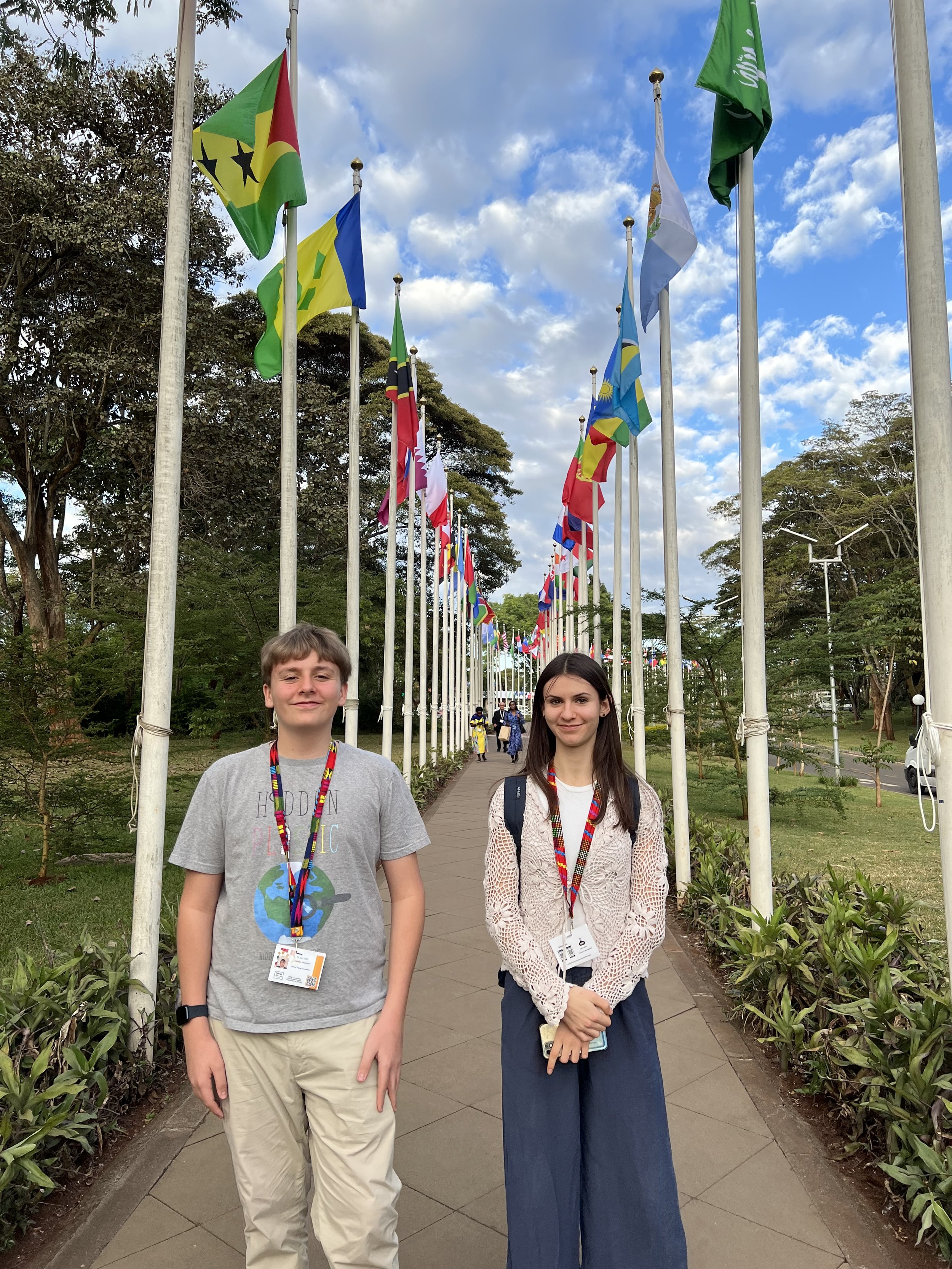
Zara Hawkins, 17, and Ashton Hawkins, 15, are the founders of Hidden Plastic, as well as two of CRIN’s Climate Advisers. Their environmental activism has brought them to four of the global plastics treaty negotiations, among some of the only delegates under 18-years-old to have taken part. In their five years of environmental work, they’ve worked with the Captain Planet Foundation, the Global Seaweed Coalition, Bowseat Creative Action for Conservation and, most recently, the Children and Youth Major Group at the UN Environment Programme where they are members of the coordination team for their newly-launched Youth Plastic Action Network.
Shirley Akinyi Ochieng is a 15-year-old environmentalist, climate activist and one of CRIN’s Climate Advisers. She currently serves as Ambassador of the Kisumu Greening Initiative, a programme that aims to increase tree cover and green spaces in Kisumu city. She has also worked on projects such as clean-ups, sustainability campaigns, awareness-raising initiatives in her community and has planted over 1,000 trees. Shirley has additionally represented young voices in national and international platforms - including essay competitions with UNICEF - and has won many awards (such as the Green Kids Award, Eco-warrior award and the most outstanding environmentalist of the year KSA). She collaborates with organisations such as Black Girls Rising.

Read other interviews on access to environmental justice with children and young people, including another with Shirley.
Sign up to our newsletter to stay updated and follow us on LinkedIn and Instagram.