VPNs have a branding problem. In the children and social media debate, they’re cast - again and again - as the digital equivalent of a man in a trench coat and dark glasses. VPNs are rarely portrayed as a technology that children can legitimately use.
Rather, they’re props in a familiar drama: nefarious actors, murky intentions, shadowy figures slipping unseen through the Internet, perhaps even into the home via a child’s device to hide what they’re doing from their parents.
The case for banning VPNs practically makes itself.
It’s a compelling story (at least for those who like black-and-white approaches). It’s also, from a technical and children’s rights perspective, wrong.
In discussions on children’s online safety and particularly given the current political appetite for banning children from social media, it’s been proposed
that children could be banned from using VPNs, too. This would be done, the logic goes, in order to prevent tech-savvy children from circumventing age checks.
This framing is an example of the domino effect in what we’ve previously termed “ban-solutionism” - the belief that prohibiting something is the same as solving it, yet without having seriously attempted to define the problem well.
But just as we’ve argued before that banning social media for children is not the answer
to the problems they face online, neither is banning children from using VPNs. As we’ll see below, VPNs are not mere gimmicks that help us change our apparent location online to avoid age checks. They are a fundamental cybersecurity technology.
From a children’s rights perspective, banning VPNs would not only fail to effectively address the underlying risks children face online, but would introduce new ones.
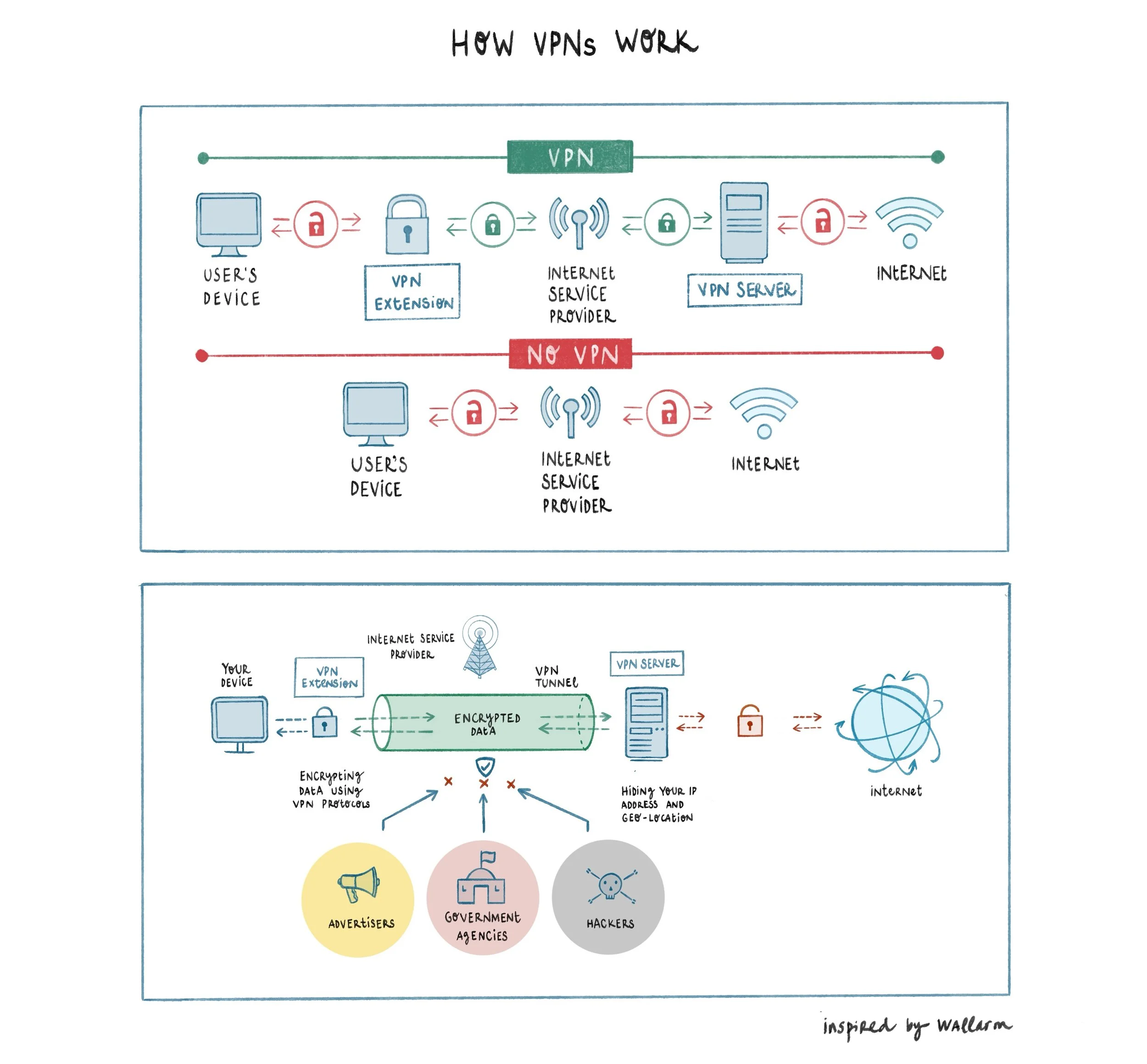
VPNs are useful for two main reasons. First, the connection is private, so our data cannot be seen, changed or interfered with by third parties. This is important because when we go online, our device is connected directly to the wider Internet through our Internet Service Provider’s (ISP) server.
Without a VPN, the ISP can see the information we send and might pass it on to third parties, advertisers or the government. Also, because the data is not encrypted, hackers could gain access to it, for example on public Wi-Fi. With a VPN, the data is encrypted, so the ISP and others cannot see it.
VPNs effectively act like a confidential tunnel through which we communicate data online - including data we want to restrict from public knowledge like passwords, location, browsing habits etc.
Second, VPNs increase our options to connect to the Internet by spoofing our real location, making it seem that we’re connecting from a different place. When we go online, ISPs give us an Internet Protocol (IP) address (similar to a postcode or a landline phone number).
Our IP indicates a general geographic location and could often publicly identify us or our household.
Without a VPN, the ISP knows where the data is coming from and where it’s going. With a VPN, our data is directed via the VPN provider’s server. This masks our real IP address. Our activity appears to come from the IP of the VPN server, which could be anywhere in the world.
Does a VPN ban make technical sense?
More broadly, it’s important to understand that VPNs are a technology. They are not a product exclusively provided commercially or used by individuals. They are a way to connect remote devices privately and securely. This is done extensively also by governments and companies.
As a technology, VPNs are fundamental to Internet infrastructure globally.
While it might be possible to enact laws to make it harder for children to connect to the Internet through VPNs - for example, by prohibiting popular commercial VPN providers from offering their services to children - it’s technically impossible to ban VPNs for children completely.
VPNs can be created and self-hosted by individuals using widely available cloud servers.
Technically skilled users, including children or those who are willing to provide a VPN service to children, can simply rent a cheap server anywhere in the world and set up
their own private network in a matter of minutes. This means that VPNs as technology will always exist, which makes banning them nonsensical because young users can always migrate to other - increasingly smaller and possibly dodgier - VPN providers.
How do VPNs support children’s rights?
While social media bans can be framed as a way to stop profit-hungry tech companies from accessing and exploiting young users,
the basis for banning VPNs for children is not that VPN providers are exploiting children; it’s to stop children circumventing age checks on social media and other websites.
In the children’s online safety debate, this marks an unsustainable escalation of the technophobic, ban-solutionist mentality and approach: if one ban wasn’t enough, then two bans should do the trick. But this raises serious concerns from a rights perspective.
What’s instead needed in the debate is an actual understanding of how VPNs can help children to exercise their rights.
An obvious starting point is that using VPNs can increase children’s privacy and security. The data children routinely transmit online includes data meant to remain confidential, like passwords or real-time location, or data which is sensitive under the law, like ethnicity, health or political opinions.
Children also use the Internet outside of their home, where their data is particularly easy to exploit. One example is public Wi-Fi in transport hubs, parks, shopping centres, libraries, restaurants, hotels etc. Without a VPN, data can sometimes be observed, copied or altered by others who have access.
This could include those who might pose a threat to children’s physical or mental safety, for example by detecting and then maliciously using information about their current location, where they live, who they communicate with or what their interests are.
Children could even be tricked into using a fake copy of a Wi-Fi network that looks just like the legitimate one they’re trying to access - effectively handing over their data to “an evil twin” network.
With a VPN, this is much harder because the data is encrypted.
Some VPN services are bundled with parental filters, allowing parents to protect children from being exposed to harmful websites.
By directing the traffic through a VPN server instead of children’s ISP servers, a VPN also prevents tracking by the ISP. And in masking the IP address, a VPN reduces the risk of targeted attacks.
From the perspective of children’s freedom from commercial exploitation, using a VPN can be useful to prevent the ISP from logging and tracking children’s browsing history and potentially selling it to third-party advertisers.
For example, in 2021, the Federal Trade Commission in the US studied
the privacy practices of six ISPs and found
that they routinely collected a vast amount of customer data, which they then shared with dubious middlemen using complex business arrangements that were often not properly disclosed to their customers.
VPNs can be crucial tools to support children’s freedom of expression and access to information, particularly in regions subject to censorship and surveillance. Masking their location gives children the ability to circumvent firewalls and view websites blocked by the government, for example around politically sensitive content, sexual health or LGBT+ rights.
Also, if children use a VPN, the ISP cannot hand their browsing history to the government.
VPNs are a basic form of protection, one that is relied upon by journalists, activists, and ordinary users who would prefer not to have their browsing continuously traced, restricted or monetised. All of whom can be children.
It’s little wonder that VPNs are illegal or heavily regulated in countries which want to keep a tight control on the information their citizens can see, like Belarus, China, Iran, Iraq, Russia, Türkiye and the UAE.
Take Russia, which mandated censorship following the invasion of Ukraine, with over 4,450 websites blocked since 2022.
About a third of all Russians use VPNs to get around the social media blocking and shutdown on foreign news outlets. Many young Russians
change their VPNs daily as major national service providers detect who’s using a VPN and actively block or restrict functionality for these users.
It’s a cat-and-mouse game with the authorities tightening their grip on the Internet in what has been dubbed “the great crackdown”.
Beyond supporting civil liberties, VPNs can also be democratising tools when it comes to children’s education, play or work. By giving them the flexibility to access resources from anywhere with an online connection, VPNs increase children’s opportunities to pursue their interests and can contribute to bridging the divide between different socioeconomic backgrounds.
So restricting VPN access would not simply affect bad actors; it would reduce children’s ability to protect themselves online, increase their visibility across networks, and remove a basic safeguard in environments that are often insecure. It could also disrupt legitimate uses by children in education and business, where VPNs are routinely used to secure remote access.
What are the limitations and disadvantages of using a VPN?
None of this is to say VPNs are without risk. Even with a VPN, although our accounts might not know where we log in from, they still know who we are when we log in, as we provide our log-in details. Cookie tracking still operates.
VPN tunnelling itself cannot protect us from viruses, malware or phishing scams. Also, VPN technology is complex, which can lead to compatibility issues, making the user experience frustrating. And VPNs are often not enough on their own to prevent modern advanced tracking.
As explained earlier, VPNs direct data to a VPN server instead of the ISP servers and make data visible to the VPN providers instead of the ISP. So they essentially concentrate trust in private companies
whose claims that they do not keep logs of users’ data are difficult to verify. Some VPN providers, especially free ones - precisely those most accessible to children, monetise user data or operate without robust security standards.
Even where the provider is reputable, directing traffic through other jurisdictions may also expose users to weaker data protections. Not all VPN providers are equally secure or trustworthy.
And of course, importantly from a rights perspective, using VPNs to access geo-restricted content or avoid age checks could violate local laws or the terms and conditions of certain platforms, including those meant to support the realisation of children’s rights. With a VPN, children could
access websites or apps blocked by parental controls or school networks, search for and view information that is inappropriate for them, and bypass time limits or usage restrictions set on devices or apps.
How do children use VPNs in practice?
Clearly VPNs are far from perfect. But they are useful and widely used, including by children. It’s estimated that a third of Internet users worldwide use VPNs, with the number expected to grow.
In the UK, for example, a 2025 survey shows that just over a fifth of children aged 8-17 have used a VPN. When asked the main reason, the majority (54%) said: to stay safe online and protect their privacy; to watch shows, videos or sport not available in their country; or to protect their privacy or data when they are using public Wi-Fi.
So a large proportion of under-18s understand two fundamentals that ban-solutionist policymakers have not yet fully recognised: that children have a right to privacy, and that their privacy and their safety online are interdependent.
Contrary to the predominant framing of VPNs as shady tools, far fewer children in the survey (15%) use VPNs mainly to get around parental controls or school Wi-Fi blocks and monitoring, or to look at things inappropriate for their age.
Another UK study from May 2026 found that only 7% of children use VPNs to get around age checks.
Why is the current framing of the VPN debate problematic?
As we saw above, VPNs change the distribution of visibility across a networked system - shielding some data from some observers, while exposing it to others. VPNs can give a child choice over who knows what. And as a technology - a means to the end, not the end itself - they are not intrinsically bad or good. So how has the debate on children, social media and VPNs become so polarised?
‘Invisibility’ with VPNs: Villainous or valorous?
As we’ve explored before, the language and metaphors we use to describe technologies shape the policies we build around them.
VPNs are often framed as akin to invisibility cloaks - both by the policymakers who want to ban them for children and by the companies that want to sell them.
Invisibility is a powerful metaphor here. It persists not because it’s accurate, but because it’s useful, as it reduces a complex technical reality to a moral binary that can be leveraged to support the respective bias and objective.
Want to ban VPNs? Argue that visible is synonymous with safe. Invisible suggests doing stuff in secret, which equals suspicious. Once that framing takes hold, restrictions on VPNs for children begin to look like common sense. Of course parents should not allow children to “hide” their activity, should they?
Want to sell VPNs? Market them as superhero cloaks allowing well-meaning users to hide from the baddies. Surely everyone, children included, should be able to avoid snooping governments, pesky advertisers and dangerous hackers?
The duality of the metaphor is not surprising. After all, in folklore, mythology and fairy tales, an invisibility cloak is either a magical item used by duplicitous characters or an item worn by a hero to fulfill a quest.
But in the policy debate, relying uncritically on one interpretation of this metaphor leads us astray. The real question is not who is hiding; it is who is allowed to see who is doing what. VPNs sit awkwardly in this space. If instead of invisibility cloaks, VPNs are understood as tools for managing trust and visibility, the conversation can become more honest about the trade-offs involved.
What are the deeper implications of the debate?
When the focus is on children, VPNs acquire a much-maligned reputation. In that respect they are similar to encryption, which we’ve researched in detail before. Concerns about online harms are real.
But like in the encryption debate, there is a difference between addressing specific risks and recasting the technologies and infrastructure of the Internet as inherently suspect. Too often, the leap is from “there are harms” to “children shouldn’t be less traceable online, just in case”. That leap deserves scrutiny.
Suggesting that positive choices about children’s privacy are something suspicious perpetuates the familiar - but flawed - dilemma of choosing between children’s protection from harm and their privacy.
It’s a dilemma that assumes, wrongly, that privacy is mostly the preserve of adults.
It really is striking how little of the structural reality of VPN technology features in the public debate. Instead, the focus remains on individual misuse: the hypothetical wrongdoer, the risky teenager, the ever-present spectre of someone getting away with something. These are easier stories to tell - and sell.
If the full benefits and risks of VPNs are not properly set out, the debate is not about VPNs; policy that’s both overbroad and under-explained is often about something else.
It’s about power - in this case, broader forms of surveillance - without saying so aloud. It’s about control over data and access to information, over being able to be less traceable online, and over the boundaries of state and business interference in our lives - something which affects children and adults alike.
A way forward... With VPNs
If we get the framing of the technology and children’s rights wrong, we risk “solving” the wrong problem. If we get it right, the conclusion is far less dramatic - and far more practical.
Do not ban VPNs for children - a ban would leave them vulnerable to a wide range of rights violations. Have genuine conversations with children about VPNs. See what they use VPNs for and explain the tradeoffs involved. Support them to use VPNs appropriately.
More broadly, understand the domino effect of ban-solutionism. Advocate for social media regulation that makes sense in the technological ecosystem, is effective and rights-respecting.
This piece is co-published with Defend Digital Me.
Sign up to our newsletter to stay updated
and follow us on LinkedIn.